How to Choose Between Carbomer 980 and Carbomer 981 for Your Formulation
Selecting the correct rheology modifier is critical to achieving the target product feel, appearance, and long-term shelf stability. While both Carbomer 980 and Carbomer 981 serve as highly efficient cross-linked acrylic acid polymers, their structural differences dictate fundamentally different performance profiles in aqueous and hydroalcoholic systems.
In this guide, we break down the visual changes before and after neutralization and demonstrate why selecting the right grade impacts your final formulation performance.
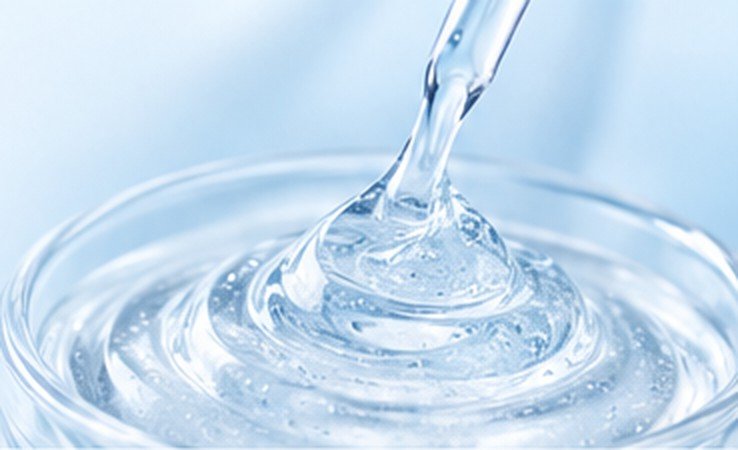
Visualizing Neutralization

Before neutralization (acidic state): low-viscosity dispersions, slightly opaque or hazy in appearance.

After neutralization (pH 6.0–7.0): immediate polymer expansion resulting in high clarity and structured gel matrices.
Carbomers require neutralization to build viscosity and structure. As an alkali (such as TEA or NaOH) is added, the carboxylic groups ionize, causing the polymer chains to uncoil and swell.
Visual Insights:
- Before neutralization (acidic state): low-viscosity dispersions, slightly opaque or hazy in appearance.
- After neutralization (pH 6.0–7.0): immediate polymer expansion resulting in high clarity and structured gel matrices.
Non-Drip vs. Flowable Test

The primary physical difference between these two grades lies in their yield value and shear-thinning behavior:
1. Carbomer 980 — Maximum Yield Value & Non-Drip Performance
Observed Behavior: As shown in the image above, Carbomer 980 forms a rigid, firm gel network that stays in place on a spatula without dripping.
Best For: Crystal-clear hydroalcoholic hand sanitizers, firm styling gels, and non-drip topical formulations.
2. Carbomer 981 — Smooth Flow & Low Viscosity
Observed Behavior: Carbomer 981 exhibits a lower cross-link density, resulting in a smooth, fluid flow that easily drips and spreads.
Best For: Sprayable lotions, thin emulsions, and active-rich cosmetic formulations where low viscosity and electrolyte resistance are required.
Technical Comparison Table
| Performance Metric | Carbomer 980 | Carbomer 981 |
|---|---|---|
| Viscosity (0.5% neutral solution) | 40,000 – 60,000 mPa.s | 4,000 – 11,000 mPa.s |
| Rheology Profile | High yield, non-drip short flow | Fluid, pourable long flow |
| Clarity Grade | Excellent (crystal clear) | Good |
| Ion / Electrolyte Tolerance | Moderate | High |
| Primary Formulations | Hand sanitizers, clear gels, thick masks | Spray lotions, low-viscosity emulsions |
Impact of Incorrect Grade Selection
Choosing the wrong polymer grade directly causes downstream quality and performance issues:
- Aesthetics & Texture: Replacing 980 with 981 in a clear gel reduces yield value, causing the product to feel runny and cheap in the customer’s hands.
- Phase Separation: Substituting 980 into an electrolyte-dense system leads to polymer chain collapse, syneresis (liquid separation), and degraded shelf-life.
- Application Control: Correct grade selection ensures predictable shear-thinning — providing a stable rest state and smooth application under shear force.
Need Samples or Technical Support?
Request a free sample kit, Technical Data Sheet (TDS), or Certificate of Analysis (CoA) from our formulation lab today.
Request Carbomer 980 / 981 Samples on WhatsApp
Or email us at sales@pvpmaterials.com
Formulating a clear gel or a sprayable lotion and unsure which grade fits your target texture? Contact us for samples, a TDS, and a CoA — or browse the full Carbomer range.